What a fantastic way to spend a few hours on a Sunday morning – on a free walking tour of Barcelona with Tyler. Tyler is a US expat who has been living in Barcelona for six years and has a love of history and this fine city,
The magnificent La Sagrada Familia is our first stop. The back story is as fascinating as the incomplete building itself.
Cast your mind back to the year 1874 when a local organisation petitioned for a church to be built honouring the Holy Family. Eight years later the first stone was laid, the first masses are conducted from 1885 in the Chapel of Saint Joseph. The architect in charge is Antoni Gaudi.

In 1891 work begins on the Nativity facade which is like wow – it is so impressive (and a little unexpected) I have zoomed in on one part so you get a sense of the detail. There is so much on this facade.
The Saint Barnabas Bell Tower was the only completed structure that Gaudi saw before his death. Gaudi’s death was actually quite sad he was run over by a tram in 1926 and left to die by the tram driver who didn’t recognise him. The story goes that two hours went by and he had lost quite a bit of blood when two men came across him and took him to the hospital but it was too late to save him.

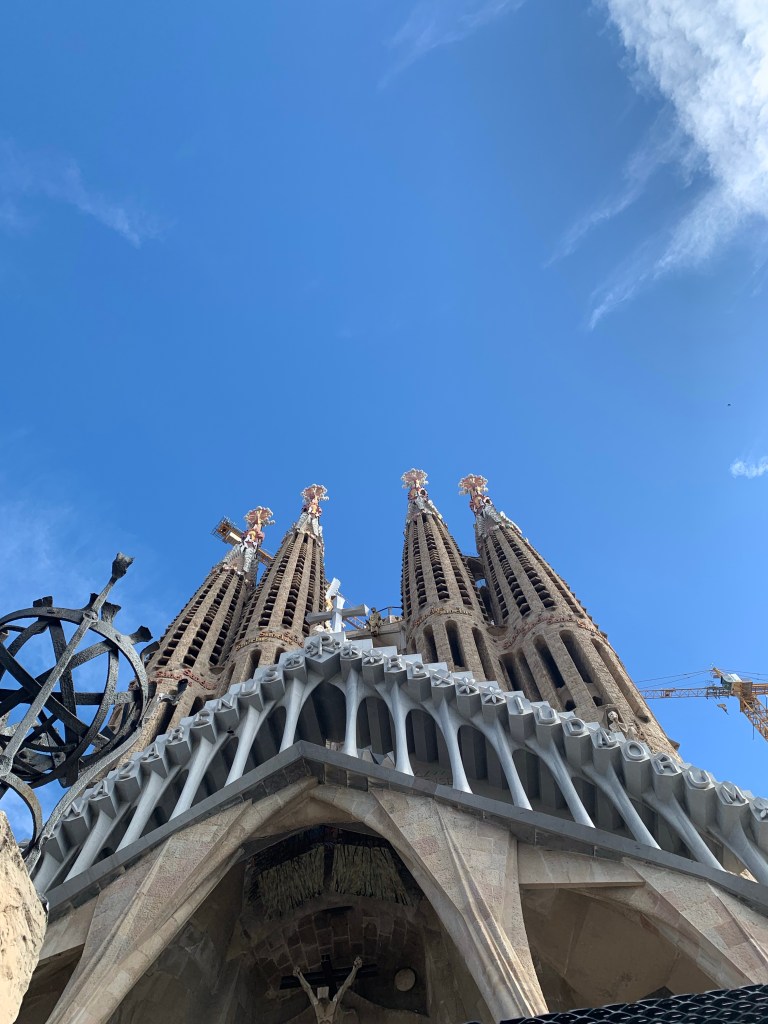

Work was interrupted by the Spanish Civil War from 1936-1939 when unfortunately many of Gaudi’s original plans as well as the model structures were destroyed. This meant that reconstructed versions of the destroyed plans had to be recreated. Architects and builders have changed over the years, there was even a battle in 2018 with Barcelona’s Mayor who sought to recoup money from this privately funded church arguing that neither Gaudi nor the construction board obtained a building permit. Government and taxes what can I tell you – $41 million went into the public coffers I guess that’s what happens if you don’t have the right building permit for 136 years.
So when will the build be finished? It’s estimated that it will be finished structurally by 2026, with the facade completed four years later in 2030. It’s a massive job. Unfinished the structure generates millions of dollars in taxes with about 4.5 million tourists a year coming to specifically to Barcelona to view it. Imagine when it’s finished ( yes I’m on that list). We are coming back here in a couple of days to go inside, you have to book in advance as it’s so popular – I can’t wait 😀.
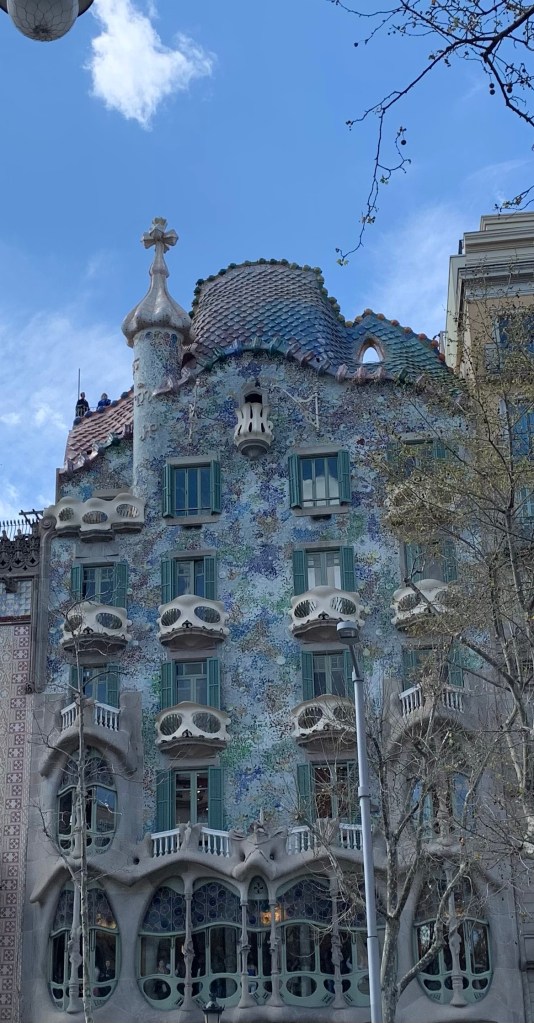
From here Tyler herded us onto the Metro and we made our way to Casa Batllocode. You may recognise the Casa it is considered one of Antoni Gaudi masterpieces. Designed in 1904 it is also known as the house of masks (the balconies are shaped like masks) or the house of dragon (the roof has scales that look like a dragons). It is so sparkly the photo doesn’t do it justice. You are able to go for a tour inside and apparently it is pretty impressive.

Our walk then took us to the outside of the Cathedral of the Holy Cross and Saint Eulalia and while we were there came across this small shrine. Tyler told us a dreadful story about a 13 year old girl named Eulalia who was martyred in Barcelona during the persecution of Christians in the reign of the Roman Emperor Diocletian. Eulalia was born in 3AD and was visited by an angel. Emperor Diocletian insisted that Eulalia retract this story and her Christian faith – she refused to. It was ordered that she suffer 13 tortures, including imprisonment in a box, being whipped, her skin being torn off in strips, walking across burning embers, branding her, and worse. She somehow survived and was then crucified on the form of a X. She now has a Cathedral named after her and there is a festival in her honour each year.
Feeling a little flat we continued to walk through the oldest part of Barcelona, Ciutat Vella which means old city in Catalan. Ciutat Vella has wonderful windy streets with surprises (for me at least) around every corner.
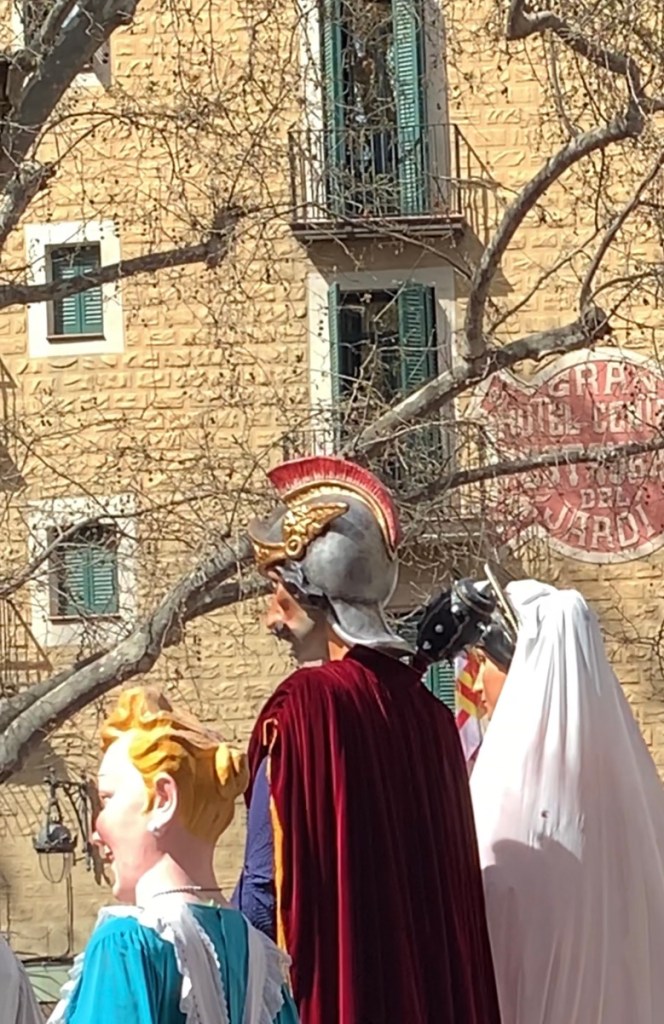
This was the first surprise Giants and Big Heads. There is an annual festival called Festes de la Merce in September (we are here in March) each year so it wasn’t that but it was some sort of street parade, with people singing and dancing and the giants certainly getting into the action. At the end of the parade there were even fireworks 💥.

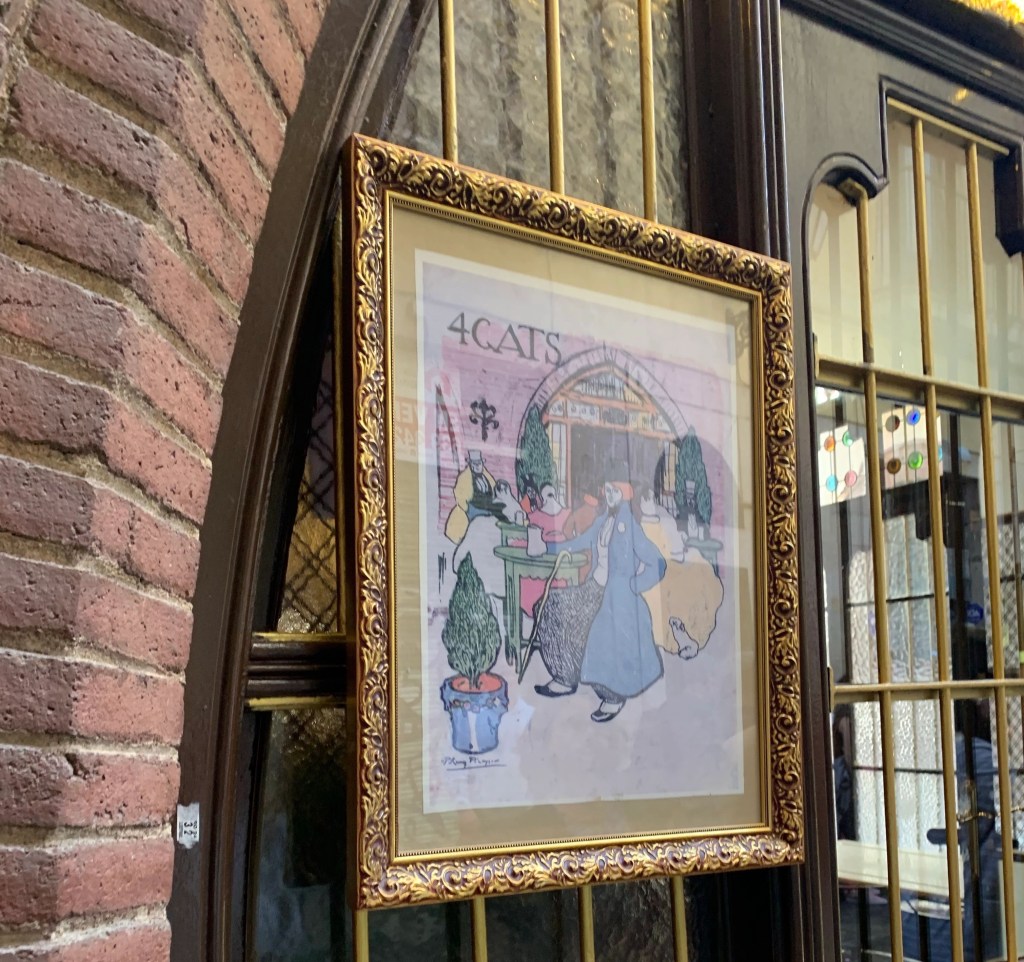
The second surprise was this little cafe Eli Quatre Gats (The four cats) which first opened its doors on 12 June 1897. Pere Romeu, with the help of some friends who financially supported him, designed Eli Quatre Gats drawing his inspiration from a French cafe he worked in Le Chat Noir. By 1899 the cafe/ piano bar was frequented by modernist and bohemian artists of the time (including his three mates who had helped finance the cafe) and a 17 year old artist by the name of Pablo Picasso. Picasso’s first solo exhibition was held here and the poster above was designed by Picasso.
Unfortunately while Romeu was a good friend he wasn’t a great businessman allowing his friends to order food at discounted prices sometimes even not requiring them to pay at all, and so went out of business in June 1903. In 1978 the cafe was reopened to the public and it was restored to its former glory in 1991.

Surprise, surprise, surprise we turn another corner and go into a building on Carrer Paradis and inside a small courtyard we find four columns from the Temple of Augustus. These columns are 2,000 years, I know right, pretty cool. It is a small space and so we only had about 5 minutes there so that others could come in. It was hidden away from the hustle and bustle of this busy city and is so quiet you could forget you were in Barcelona.
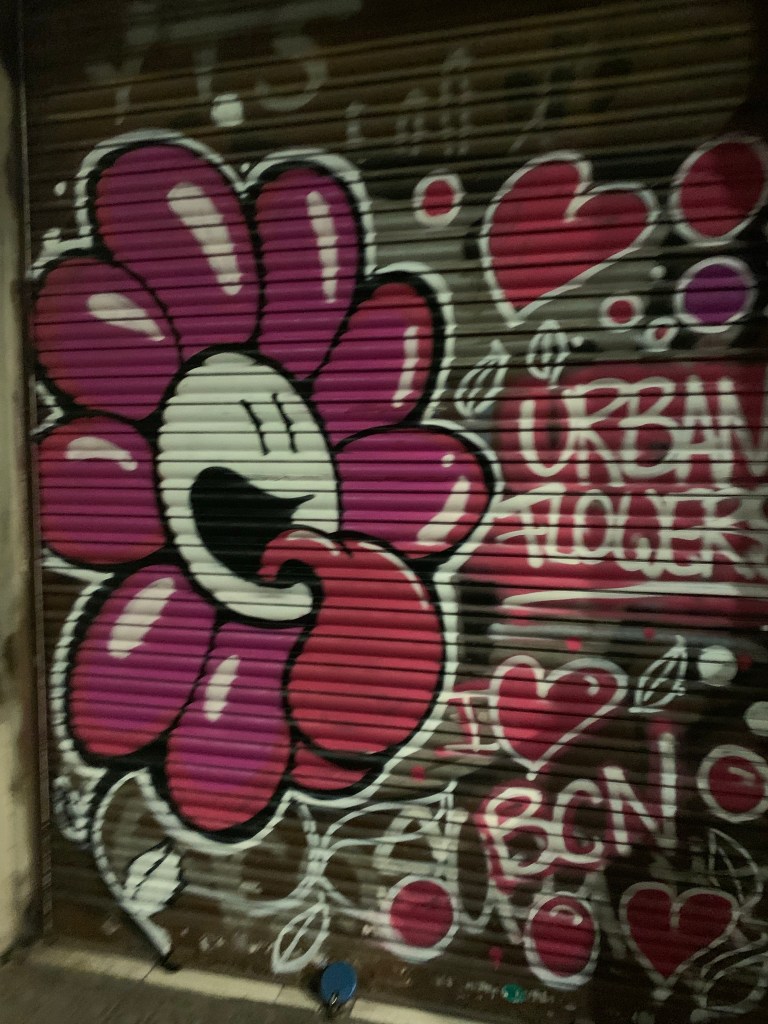
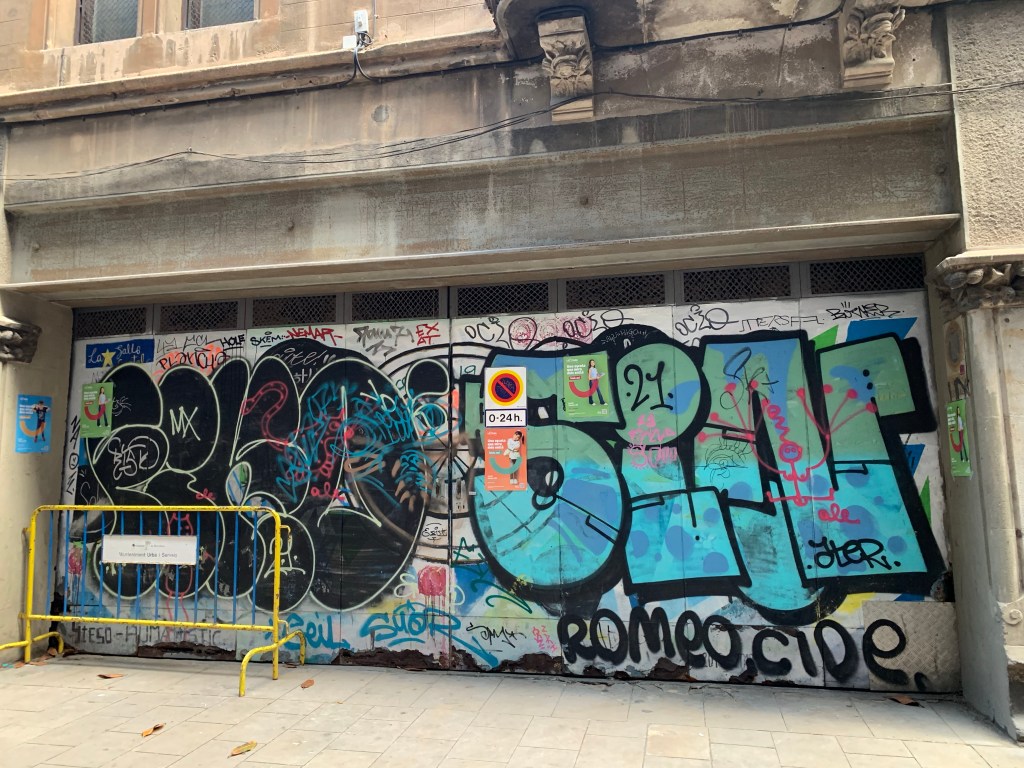
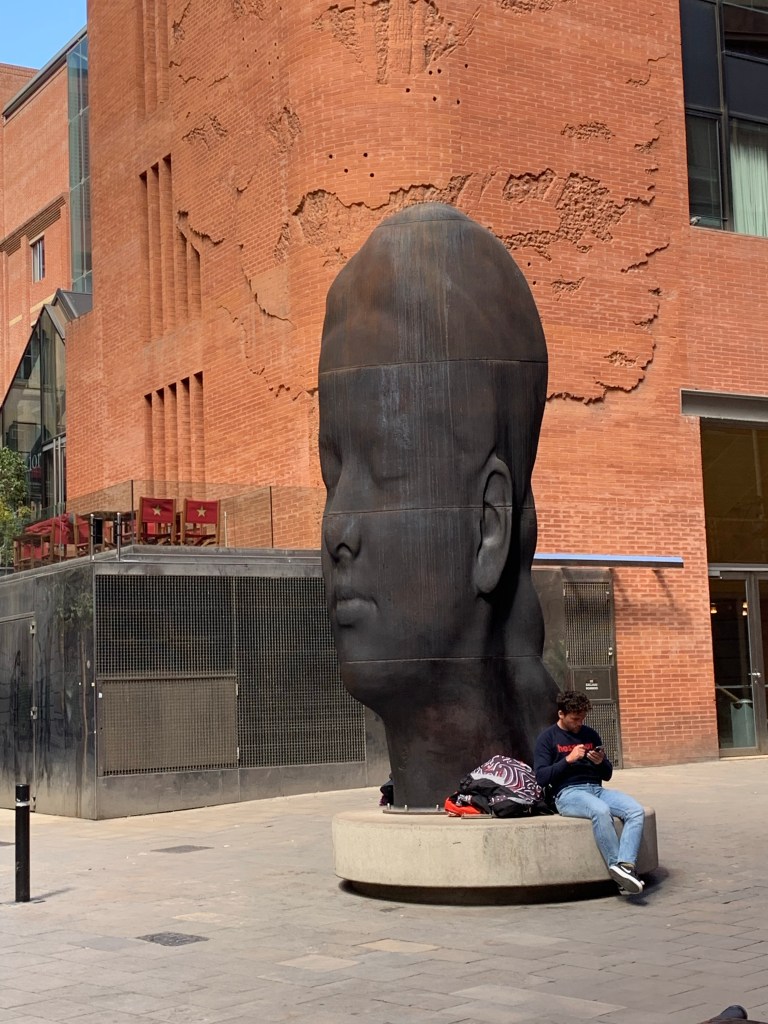
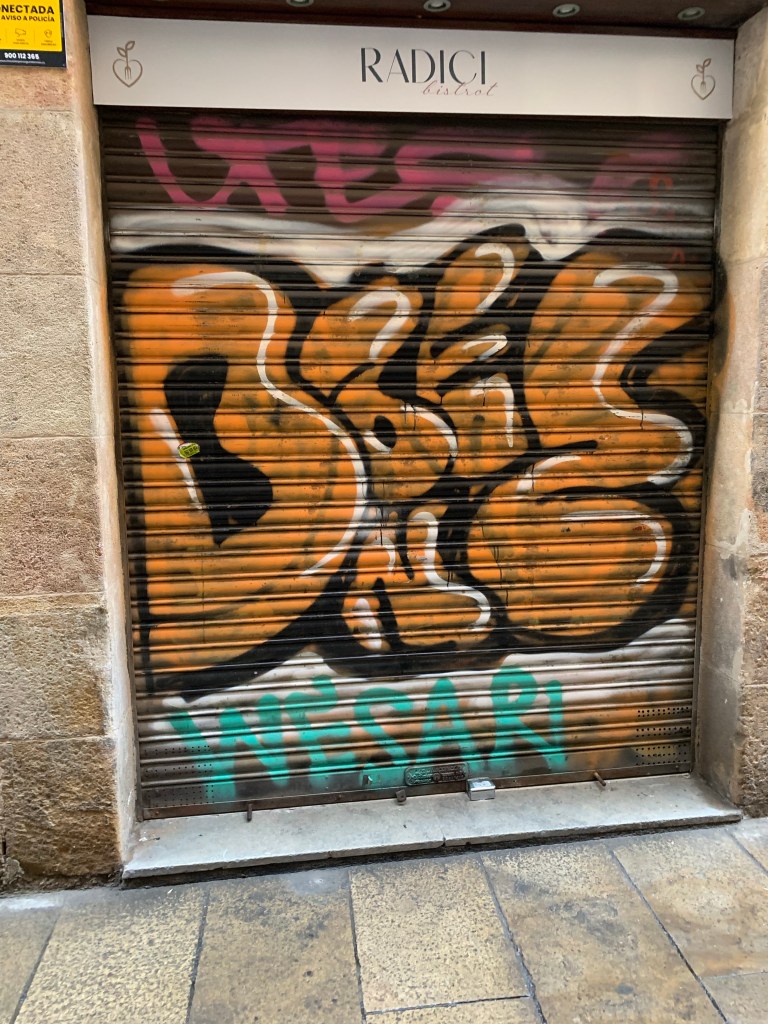
That’s the things about Barcelona it is such a wonderful mix of modern, old and ancient. Here are a few examples of the street – magic. You can actually do a street art and graffiti tour here, but I don’t think we have time, which is a real shame.


In relation to the list of things that Barcelona is renowned for today we’ve ticked off architecture, festivals and street parties, and famous artists and writers.
Tomorrow we are off to Guell Park


 Travelling with Fi
Leave a comment